
Your Breakfast Is a Business Decision. Most High Earners Are Making It Wrong.

Let me share something I noticed in my own life long before I understood the science behind it.
On mornings when I skipped breakfast, which, during my busiest years, was most mornings, I felt sharp at 9 am, but noticeably less clear by 11. Not because I had more energy early on, but because I was running on cortisol.
By the time an important call or decision came around at noon, I was already operating on depleted reserves but calling it “focus.” At the time, I thought it was a discipline issue. That I simply needed to push harder.
It wasn’t discipline. It was biochemistry working against me, quietly and consistently.
And I see this pattern repeated across high-performing professionals every day.
Here is what the research actually shows and why it matters for anyone in Wealth Nation making high-stakes decisions daily.
"Your breakfast is not a meal. It is the first business decision you make every day. Most high earners are making it by default. – Dr. Meetu Bhatnagar"
Physical Health & Vitality — PILLAR 1 DECODED: Why What You Eat Directly Affects What You Earn
The part of your brain responsible for strategic thinking, risk assessment, and decision-making, the prefrontal cortex is the most metabolically demanding region in your nervous system.
It is also the first to be affected when: Blood sugar drops, Cortisol remains elevated, Low-grade inflammation accumulates.
This is not a theory. It is neuroscience, and for high earners, the implications are significant.
- What happens when you skip breakfast: Blood glucose begins to decline within two hours of waking. Cortisol is already elevated as part of your natural waking response, which stays elevated longer than it should. The prefrontal cortex is among the first areas to lose efficiency under these conditions. Landmark review (Rampersaud et al., Journal of the American Dietetic Association) consistently found breakfast consumption improves memory, attention, and cognitive performance.
- What happens with a high-protein breakfast: Blood glucose remains stable for 4 to 6 hours. Key neurotransmitters linked to focus and mood are activated through protein intake. Research (Leidy et al., American Journal of Clinical Nutrition) shows high-protein breakfasts improve satiety, reduce hunger, and lead to better overall decision-making.
THE WEALTH NATION KITCHEN — ISSUE 02: The Power Bowl
High-Protein Cognitive Performance Breakfast | Ready in Under 10 Minutes
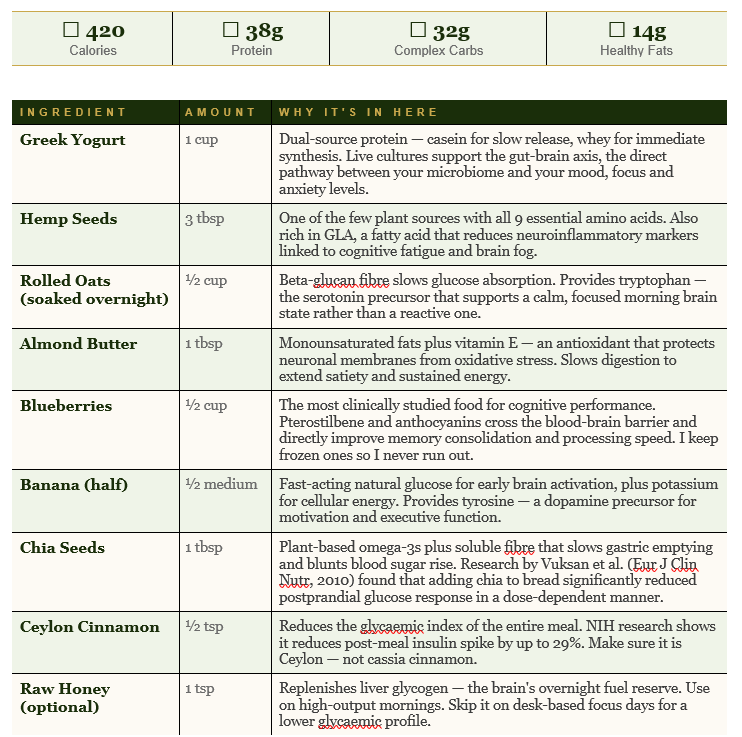
Let me be clear: I didn’t create this bowl for convenience alone, though it is convenient. I created it because I was tired of the gap between what I knew about nutrition… and what I was actually doing. Every ingredient in this bowl has a purpose. Nothing is decorative. Everything contributes to performance.
METHOD — THE 10-MINUTE PROTOCOL
Step 1 — The Night Before (2 Minutes): Combine rolled oats and chia seeds in a wide-mouth jar or bowl. Add cold water or unsweetened almond milk. Stir once, cover, refrigerate.
Step 2 — Build the Base: In the morning, spoon Greek yogurt into a bowl. Add the soaked oats and chia on top. The temperature contrast between cool yogurt and soft oats creates sensory satisfaction that signals fullness faster.
Step 3 — Layer the Performance Ingredients: Add blueberries, half a banana sliced, hemp seeds and almond butter across the top. You are building a neurological environment, not assembling a smoothie bowl.
Step 4 — Finish and Calibrate: Dust with Ceylon cinnamon. Add raw honey only if you have a physically demanding morning or an early start requiring immediate cognitive output.
Step 5 — The Executive Version (Under 90 Seconds): Layer everything in the jar the night before yogurt on the bottom, soaked oats on top, and toppings in a separate small container. Morning time: open jar, add toppings, eat. Time mastery applied to fuel.
"Wealth Nation does not eat for comfort alone. We eat for cognition. Every meal is a choice about who shows up in the next four hours. – Dr. Meetu Bhatnagar"
PERFORMANCE NUTRITION – 5 RULES WEALTH NATION LIVES BY
The High-Performer Eating Protocol — These are not diet tips. They are leverage points:
- Rule 1: Eat Within 45 Minutes of Waking — Cortisol peaks 30 to 45 minutes after rising (Cortisol Awakening Response). Eating protein and complex carbohydrates within this window stabilises your neurochemical baseline.
- Rule 2: Hydrate Before You Caffeinate — At 1–2% dehydration, measurable impairments in short-term memory, attention and psychomotor speed occur. Drink 500ml of water before coffee.
- Rule 3: Protein First — At Every Meal — Triggers GLP-1 and PYY satiety hormones, slowing gastric emptying and reducing post-meal energy crashes.
- Rule 4: Engineer Away the 3 pm Crash — Replace refined carbohydrates at lunch with protein paired with fibrous vegetables and healthy fats to avoid insulin-driven troughs.
- Rule 5: Treat Omega-3s as Cognitive Infrastructure — 2–3g of combined EPA/DHA daily supports neural transmission speed and cognitive reserve.
WEALTH NATION WEEKLY STAPLES LIST
- Greek yogurt (plain, full-fat, 32 oz tub)
- Rolled oats, old-fashioned, not instant
- Hemp seeds and chia seeds
- Natural almond butter (no added sugar or oils)
- Frozen blueberries (no spoilage, always available)
- Bananas and seasonal berries
- Pasture-raised eggs
- Wild-caught canned salmon or sardines
- Raw mixed nuts: walnuts, almonds, Brazil nuts
- Ceylon cinnamon, raw honey, quality sea salt
Know someone who needs to read this?
Share this insight with a doctor, business owner, or professional in your life who is building something meaningful.
Next Step
Evaluate Your 7 Pillars of Wealth
Perspective is the first step. Take the free 2-minute Wealth Score to identify which of your 7 Pillars is strongest and where your greatest opportunity lies.
Take the Free 2-Minute Wealth Score