
You Are Earning Well. You Are Not Building Wealth.

Let me start with something I see all the time.
A physician walks into a meeting or an entrepreneur or a real estate investor running a seven-figure business. Sharp, Disciplined, Earning well above average and then we sit down and look at what they actually own… versus what they earn.
That’s where things start to feel off.
High income, Decent savings, a primary home with equity or maybe a retirement account they check once a year. And almost nothing that generates income without them.
According to Medscape’s 2024 Physician Wealth and Debt Report, 28% of physicians have a net worth under $500,000. Nearly half have less than $1 million. This is while earning, on average, $374,000 per year. The math should work differently. It doesn’t because earning and building are not the same skill.
Pillar 2 – Financial Mastery doesn’t begin with investment tactics. It begins with a much more direct question: Are you building an architecture or just sustaining an income stream?
"High income is not the same as wealth. A physician earning $400K a year with no tax strategy, no passive income, and no investment structure is not wealthy; they are income-dependent. That is a very comfortable treadmill. – Dr. Meetu Bhatnagar, Ph.D., CCIM"
THE DATA — WHAT IS ACTUALLY HAPPENING: The Uncomfortable Numbers Most High Earners Ignore
- 28% of physicians earning ~$374K/year have a net worth under $500K
- ~40% of their net worth is tied up in their primary residence, an illiquid, non-income-producing asset
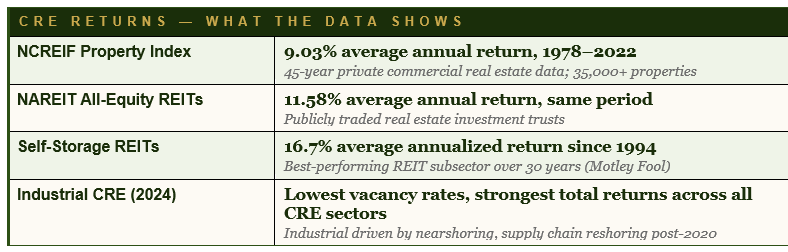
- 9.5% is the long-term average annual return of commercial real estate
- 100% of most physicians’ income is active
THE FRAMEWORK: The Three Shifts That Separate High Earners From Wealth Builders
Shift 1: From Income Focus to Asset Focus — An income-focused mindset asks: How do I increase my earnings? An asset-focused mindset asks: How do I acquire assets that generate income without my involvement?
Shift 2: From Net Income to Net Worth Architecture — Your paycheck is not your wealth metric. Your productive net worth is. Look at what portion of your net worth is working, compounding, and producing cash flow.
Shift 3: From Passive Tax Compliance to Active Tax Strategy — Taxes are the largest wealth drain for high earners. At a 37%+ federal and state tax rate, a significant portion of income is lost before it compounds. Real estate changes this equation when used intentionally.
THE MECHANISM — COMMERCIAL REAL ESTATE AS FINANCIAL ARCHITECTURE
Commercial real estate combines five key wealth-building levers into one asset class: Cash flow, Appreciation, Leverage, Depreciation, and Tax deferral.
THE THREE TOOLS — WHAT EVERY HIGH EARNER SHOULD UNDERSTAND
Tool 1: Depreciation – The Paper Loss That Reduces Real Taxes — For commercial real estate spread over 39 years, a $1M property generates ~$25,641/year in deductions, saving ~$9,487/year in taxes at a 37% bracket.
Tool 2: Cost Segregation – Accelerating Depreciation into Year One — Reclassifies property components into 5, 7, or 15-year lives. Combined with bonus depreciation, a $1M property could generate $255,432+ in first-year deductions.
Tool 3: The 1031 Exchange – Compounding Without Tax Interruption — Allows selling a property and reinvesting proceeds into a replacement property, deferring capital gains taxes entirely and preserving 100% of capital growth.
"Real estate is unique in its ability to defer capital gains taxes. The 1031 Exchange is a powerful tool especially valuable for high-net-worth individuals looking to preserve and grow wealth through real estate. – Trinity Real Estate / IRC Sec 1031"
THE MARKET CONTEXT — WHERE COMMERCIAL REAL ESTATE STANDS IN 2025 AND 2026
Commercial real estate values corrected ~18% from early 2022 to mid-2024. Experienced investors accumulate during corrections. According to Deloitte's CRE Outlook, credit conditions are improving and loan origination is up 90%+ year-over-year, signaling a narrowing recovery window.

THE FRAMEWORK — HOW TO BUILD THE ARCHITECTURE
Step 1: Diagnose Before You Deploy — Understand net worth composition, active vs passive split, and effective tax rate.
Step 2: Tax Reduction Before Investment Return — Sequence matters. Coordinated tax planning saves $50K–$100K+ annually.
Step 3: Build the Income-Producing Asset Base — Acquire cash-flowing commercial real estate, businesses, or structured real assets.
Step 4: Protect What You Build — Implement proper entity structures (LLCs, trusts, partnerships) to separate personal liabilities.
Step 5: Measure It — Track net worth, passive income percentage, effective tax rate, and portfolio returns quarterly.
Know someone who needs to read this?
Share this insight with a doctor, business owner, or professional in your life who is building something meaningful.
Next Step
Evaluate Your 7 Pillars of Wealth
Perspective is the first step. Take the free 2-minute Wealth Score to identify which of your 7 Pillars is strongest and where your greatest opportunity lies.
Take the Free 2-Minute Wealth Score